
Date of celebrations: 22nd August 2021
Day : Sunday
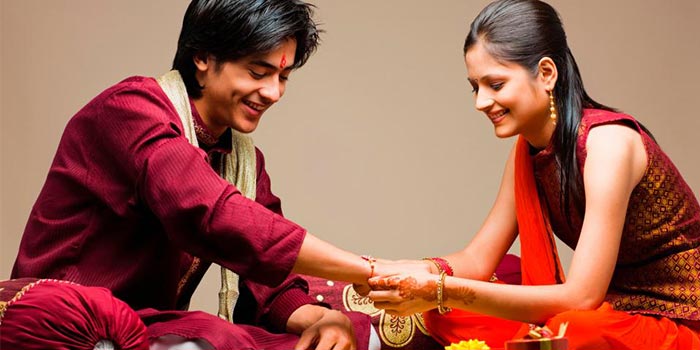
Raksha bandhan is one of the most popular festivals in India. Celebrating the divine bod of love between brother & sister, Raksha Bandhan is also known as 'Rakhi'. Sisters tie a delicate cord of 'Rakhi' on their brother's wrist, pulsating with sublime sentiment and pray for their long life. Brothers, in turn, give them enticing rakhi gifts and vows to protect and care for them life long.
Raksha bandhan is one of the most popular festivals in India. Celebrating the divine bod of love between brother & sister, Raksha Bandhan is also known as 'Rakhi'. Sisters tie a delicate cord of 'Rakhi' on their brother's wrist, pulsating with sublime sentiment and pray for their long life. Brothers, in turn, give them enticing rakhi gifts and vows to protect and care for them life long. Thus, the affectionate festivity of Raksha Bandhan becomes a token of blessings, wishes, enthusiasm & love.
Raksha Bandhan is celebrated on the full moon day of the month of Shraavan (as per Hindu calendar), i.e. in the months of July and August. As Rakhi is celebrated as per the Hindu calendar the dates may vary year after year. In 2020 - Raksha Bandhan will be celebrated on Monday, 3rd of August.
Rakih ceremony is one of the most interesting and loving ceremonies performed in India. An amazing bond of love shared among siblings is what celebrated on the day of Raksha bandhan. Sister select the brightest and the best designed 'Rakhi' for their brothers. Then they prpare the sacred 'thaali' to perform the 'aarti' of their brothers. Best of the sweets along with the Rakhi, vermillion and few grains of rice form part of the pooja thali. Brother's aspire to strive for thr protection of their loving sisters and facilitate them with exclusive gifts. On this Rakhi occasions gifts are exchanged and special Rakhi Recipes like Ghevar, Vermicelli Kheer, Malpua , Kesar Burfi , Pista Sandesh & Rava Laddoo are prepared to fill this day with lots of sweetness...
Keeping up with time, the Rakhi thread has become more fashionable and trendy. It flaunts the amalgamation of tradition and modern lifestyle of people. Modern rakhi is available in different shapes, sizes and materials. It can even be made of gold attached with diamonds. In the Indian market, few interesting varieties of rakhi are as the following:
Rakshabandhan festival is all about love, care and righteousness. Tying of a frail Rakhi thread- that is considered more stronger than iron chains-has been the tradition of this festival since the time immemorial. Even today the customs and traditions are the same but the way of celebrating the Rakhi festival has been changed. Different ways are used to express the emotions attached with the relationship.
POST has been the most traditional method to get in touch with the relatives. Sisters unable to meet their brothers send their Rakhis by post. Every year the postal department makes special arrangement to send Rakhis all over.
INTERNET & E-COMMERCE has changed the way of sending Rakhis. Being very fast and reliable sending Rakhis via net is so much in use. With the time changing sending
E-mails & ONLINE RAKHI GREEITING CARDS are considered fast and inexpensive way of celebrating the festival. The modern celebrations of Rakhi festival has also included the way of sending the gifts ONLINE. Sisters and brothers use this facility to select & send gifts online to far off places, from the comfort of home or net cafe.
The king of devils Bali was a great devotee of Lord Vishnu. One day Bali approached to Lord Vishnu for safeguarding his kingdom. Lord Vishnu took this task and decided to leave his heavenly home, but Goddess Laxmi wanted his husband not to leave his home. She reached to the house of Bali as a camouflaged Brahmin woman and asked for shelter.
On Shravan Purnima day Laxmi Ji tied a sacred thread on the wrist of King Bali and revealed her purpose for being there. Touched by the concern of Laxmi Ji towards her family, King Bali requested Lord Vishnu to live with her. Therefore the Rakhi festival is also called 'Baleva' that means the devotion of King Bali to Lord Vishnu.
Before the battle of Mahabharata, Lord Krishna told Yudhisthir, elder Pandava brother, to perform rakhi ceremony which would act as a shield for him and his army. Draupadi, wife of the Pandavas, tied a thread on Lord Krishna?s wrist, seeking his blessings for her husbands.
Another rakhi tale comes from the battle between Alexander the Greek king, and Porus, the Hindu king. Wife of Alexander sent a sacred thread to Porus, asking him not to harm her husband in battle. In accordance with Hindu traditions, Porus gave full respect to rakhi. In the battlefield, when Porus was about to deliver a final blow on Alexander, he saw the rakhi on his hand and restrained himself from attacking Alexander personally.
Many different traditions are followed during the day of Raksha Bandhan some of the special ones include:
Nariyal (Coconut) Purnima is celebrated in the west on the day of Raksha Bandhan. Coconuts are thrown in to the sea as a mark of respect and offering to Lord Varuna.
In the southern part of India the day of Raksha Bandhan is celebrated as Avani Avittam. This day is auspicious especially for the Brahmin community as they change their religious symbol of janeyu (holy thread) amidst chanting of mantras.
Rakhi Purnima also called Kajri Navami and Kajri Purnima is a celebration in North India when wheat is sown. Goddess Bhagwati is worshiped and the farmers seek her blessings for a good crop.
Rakhi ceremony was initiated long back in 1905 by Rabindranath Tagore in Shanti Niketan and the custom is still followed religiously by the students of Shanti Niketan.
Near or far wherever u r My best wishes r with U, Tum jiyo hazaron saal, May success & joy be yours everyday, Yehi hai meri wish dil se! "Happy Raksha Bandhan"
You were always my best friend looking out for me, making sure the path I traveled on was smooth. Even if I searched the world over,
there cannot be a better brother than you. Wishing You Life's Best Always.
ou are the person who holds me in my bad times, you are the person who dances with me in my happiness. I can't recall even a single day when you were absent from my life. I really love you my brother.. Happy Raksha Bandhan!
Brothers are like streetlights along the road, they don't make distance any shorter, but they light up the path and make the walk worthwhile.
If I can choose my brother in next life, it'll b u (if u gift me a Mercedes Benz 2morrow :) Love you always. Happy Raksha Bandhan
Sisters is probably the most competitive relationship within the family,
but once sisters are grown, it becomes the strongest relationship.
God sent in my life a beautiful Angel in your guise, Sister. In good times or bad ones,
you're ready to extend your help and support. Thanks for all you do.
Sister is someone who is caring and sharing. Sister can understand things you never said She can understand pain which is not visible to anyone.
I love my sister.
God gave me the greatest gift I ever had, God gave me a best friend in the form of my sister. Raksha Bandhan wishes for a sis who is one in a million!
"I just want to let you know,
You mean the world to me
Only a heart as dear as yours
The many things you've done
All the times that you were there
Help me know deep down inside
How much you really care
Even though I might not say
I appreciate all you do
Richly blessed is how I feel
Having a brother just like you
A sister's a sister forever,
A bond that diminishes never,
A friend who is kindly and caring,
A sibling God chooses for sharing.
Few ties as deep and profound
And with so much affection abound
Though some thoughts are seldom expressed
Love endures and survives every test.
Of the constants that rest in the heart,
A sister's a primary part.
She'll always be there when you need her-
You listen, you value, you heed her.
As growth, independence you ponder,
Your feelings grow deeper and fonder;
And life tells you one thing that is true:
A sister's a large part of you.
Here's to my brother
Remember every day
No matter what I've said
Here's what I'd like to say
I will always love you
Be with you till the end
When no one else is around
I will be your friend
I love my brother
and I always will
I'm proud to be your brother
that's how I feel
I'm gonna whisper
I love my brother
And you'll know it in your heart
"There's no other love like the love for a brother. There's no other love like the love from a brother."
by Astrid Alauda
A brother is a friend given by Nature."
by Jean Baptiste Legouve
"Sometimes being a brother is even better than being a superhero."
by Marc Brown
"It takes two men to make one brother"
by Israel Zangwill
"After a girl is grown, her little brothers - now her protectors - seem like big brothers."
by Astrid Alauda
"Having a sister is like having a best friend you can't get rid of. You know whatever you do, they'll still be there."
by Amy Li
"What's the good of news if you haven't a sister to share it?"
by Jenny DeVries
"Sisters are blossoms in the garden of life."
Author Unknown
"Sisters are for sharing laughter and wiping tears."
Author Unknown
Bhaiya Mere Raakhi ke bandhan ko nibhana - Chhoti Behan
Yeh Rakhi Bandhan Hai Aisa- Beimaan
Behna Ne Bhai - Resham Ki Dori
Chanda Re Mere Bhaiya - Chambal Ki Kasam
Phoolon Ka Taron Ka - Hare Rama Hare Krishna
Rang Birangi Rakhi Lekar - Anpadh
Love, care and affection of a brother-sister relationship can never be redeemed at any cost. However, special gestures like having a quality time with each other or buying some gifts can be a great idea. We bring to you some of the most popular gift ideas on the occasion of Raksha Bandhan :
Check out the new trends of apparels in market and shop for an exclusive dress for your sister. Don't forget to consder your sister's choice and going by season.
Surprise your sister with a set of stunning jewelry that will enhance her personality. Choose from antique jewelry, bracelets, rings, earrings, pendants, chains etc.
Gift your sis a beautiful leather bag to make it a lifelong posession of love. Beaded bags and wallets with lots of mirror work will surely show some magical effects.
Give an adorable expression to your sister with silky and cute soft toys. Sweet soft toys are best way to express your tender emotions and feelings for your cute sis.
Present your sister some household items like paintings, show piece, candle stand or even utensils. Such items will not only beautify her place but also provide lifetime remembrance.
Get around and shop for some decorative items like like showpiece, photo frame, hanging bells etc. Intricately designed with wonderful message can feel your sister how strong bonding both of you enjoy.
Bring on mouthwatering cakes and chocolates loaded with your love and care. Creamy, soft cakes will surely test her taste buds. A big pack of her favorite chocolate will surey bring a big smile on her face.
he most common gift for sisters on raksha Bandhan is cash money. Facilitate the most beautiful girl in your life - your sister with some money in cash. She will use it according to her will.
Gift your brother a quality shirt in his favorite color.
Add some style to your brother's personality by gifting him a beautiful watch.
Treat him to a fantastic box full of sweets.
A beautiful and useful cellphone gadget is sure to cheer up your brother on this wonderful day.
Choose from our range of wallets which will surely prove to be a good choice of a gift for your brother on Raksha Bandhan.
The beautifully decorated Rakhi Thali gives an impression of your love and care for your brother. The thali contains one diya, tika or roli, rice, beatle leaves, rakhi thread, flowers and incense sticks. The thali is either of silver, brass or simply of steel. Sweets sometimes add to the decor of the thali. Few types of Rakhi Thali are cited below:
It includes puja items like diya, rice and roli and sweetmeat. Petals of flowers are arranged as the base in a bronze or stainless steel thali. Use fresh colorful flowers to decorate them only on the thali's rim or on entire thali. Further decorations involve the use of single color flowers only or the use of only the petals so that the thali looks pretty.
This thali uses sweets as decorative items. Various options available for decorating piha thali with sweets include full pieces of sweets in a decorative manner in the thali, small pieces of sweets by cutting them into different shapes or a combination of both the ideas. Puja items are placed in between the sweets.
Dry fruits like cashew nuts, chestnuts, raisins, cocoa nut, pistachio or almond can also be used to decorate puja thali on Raksha Bandhan. Various measures can b adopted involving use of dry fruits like placing them one after another, in circles, making an entire base of mixed dry fruits in the thali, and then place the puja items.
This is a unique decoration for Raksha Bandhan puja thali. The area of the thali is divided by drawing lines of chocolates and toffees with one puja item placed in every division. It gives an exclusive look to puja thali.
It is one of the basic types of puja thalis for Raksha Bandhan. It uses a thin paste of roli & turmeric powder mixed together which gives a traditional look to pooja thali. Using a bronze thali & placing puja items after the paste is dried gives an ecstatic look.